
How the Granite Industry Built Rockport—and Left Its Mark Across America

The Short Version
Rockport's granite quarries supplied stone for some of America's most important 19th-century infrastructure — including the Brooklyn Bridge, Boston's Custom House, and the Charleston Navy Yard. The industry employed thousands of Irish, Finnish, and Italian immigrants who cut granite by hand using steam drills and blasting powder. By the early 1900s, reinforced concrete replaced granite as the dominant building material, and the quarries fell silent. Today, Halibut Point State Park preserves one of the last working quarry sites, where visitors can still see the cuts and ledges that built a nation.
Discover how Rockport's granite quarries helped build America's cities, harbors, and landmarks.
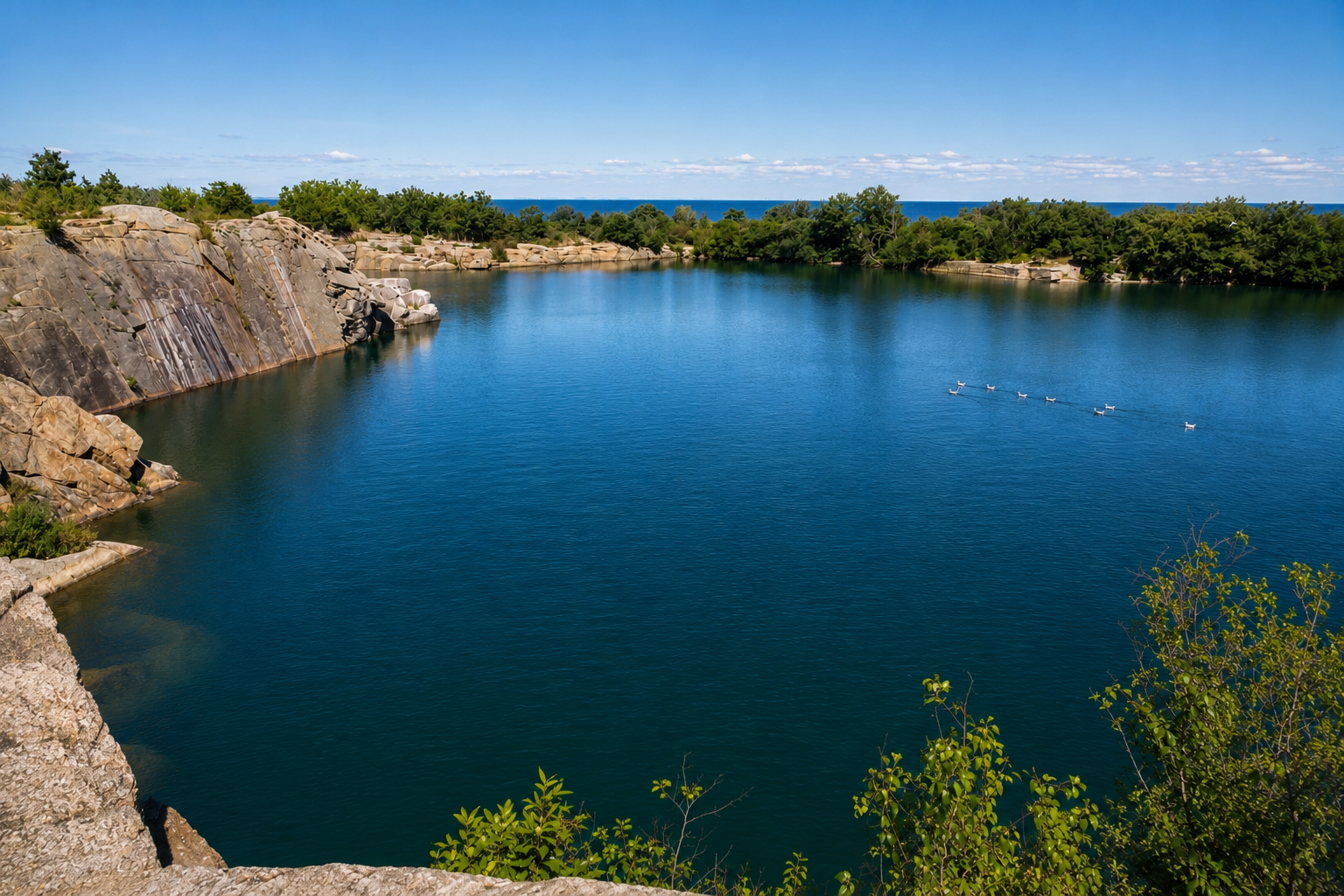
Imagine standing beside a quiet granite quarry overlooking the Atlantic. The water is calm, reflecting the gray November sky. The only sounds are wind and gulls. The machinery is long gone. The silence feels timeless.
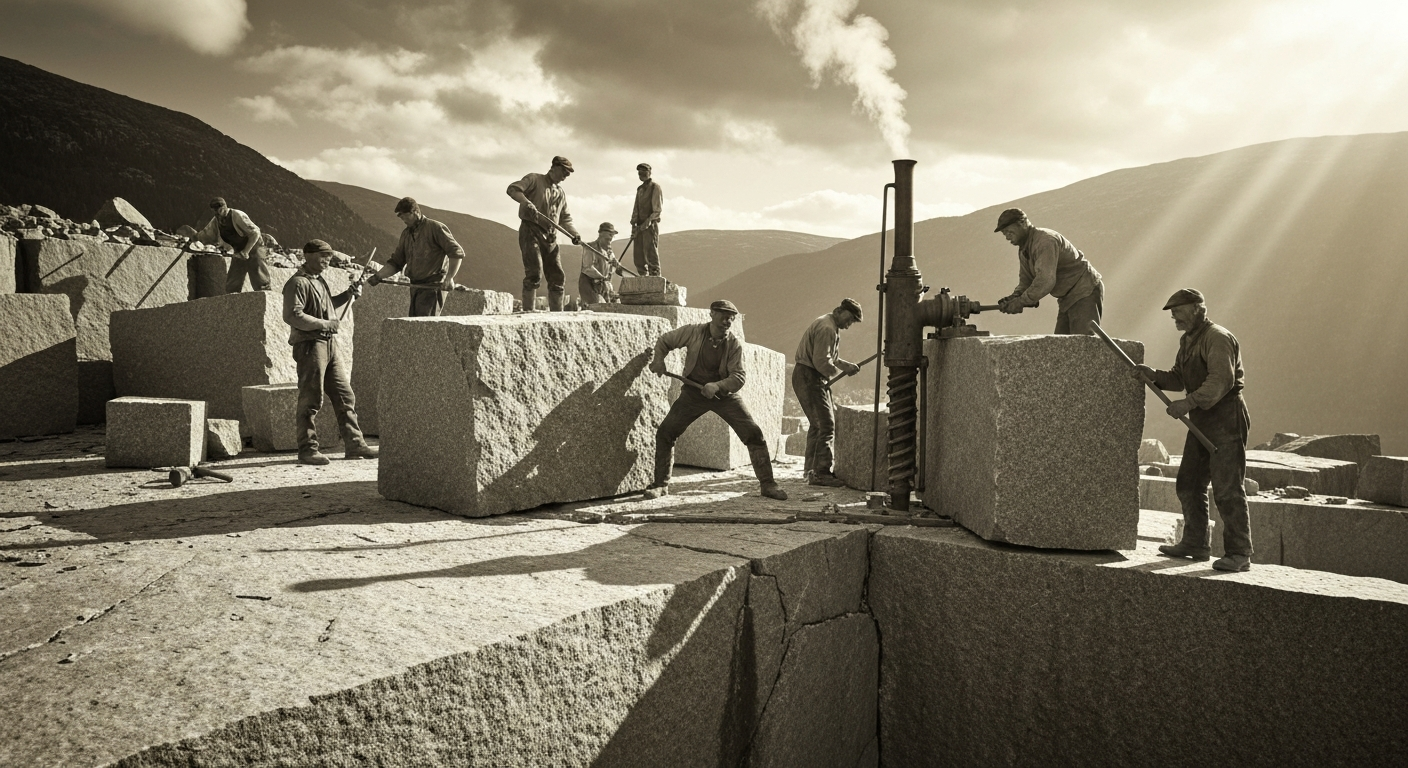
A century ago, this same place echoed with steam drills, blasting powder, the shouts of Irish and Finnish workers, and the rumble of horse-drawn carts hauling stone that would eventually become part of America itself.
Why Rockport Became America's Granite Capital
In the early 1800s, America was building at a furious pace. Cities were expanding across the North Shore, including neighboring towns like Essex. Canals were being dug. Harbors needed seawalls. Bridges needed foundations. Government buildings needed stone that would last centuries.
The key was the rock itself. Cape Ann granite — particularly the fine-grained, light-gray stone from Rockport's quarries — was prized for its density, durability, and consistent color. It resisted frost and saltwater, making it ideal for harbor work, seawalls, and bridge piers exposed to harsh New England winters and ocean spray.
Geologically, the Cape Ann granite was formed hundreds of millions of years ago. It is part of the same rock formation that underlies much of the North Shore. The stone was close to the surface in Rockport, making it accessible to quarrymen with the tools of the era — hand drills, feathers and wedges, and later, steam-powered channeling machines.
The Quarries and the Men Who Worked Them
The granite industry in Rockport was not a single operation. Multiple quarries dotted the landscape from the Sandy Bay area to what is now Halibut Point. The largest operations employed hundreds of men at a time when work was brutal and dangerous.
The workforce was overwhelmingly immigrant. Irish laborers arrived first, fleeing famine in the 1840s and 1850s. Finnish workers followed later, bringing expertise from Scandinavian quarrying traditions. Italian stoneworkers came to handle the finishing work — the precise cutting and carving that turned raw blocks into architectural elements.
Work in the quarries meant long days of physical labor in all weather. Drillers spent hours driving hand-held drills into granite by striking them with hammers, rotating the drill after each blow. Steam drills eventually mechanized this process, but they were deafening and produced clouds of dust that caused silicosis — a lung disease that shortened many quarrymen's lives.
Blasting was done with black powder and later dynamite. A single blast could loosen tons of stone, but it could also kill if the charge was miscalculated. Accidents were common. Quarry workers who lost fingers, hands, or eyes were a familiar sight in Rockport.
How Rockport Granite Reached the World
Getting the granite out of Rockport was an engineering challenge in itself. The quarries were located inland, but the stone had to reach ports, railroads, and ultimately construction sites across the country.
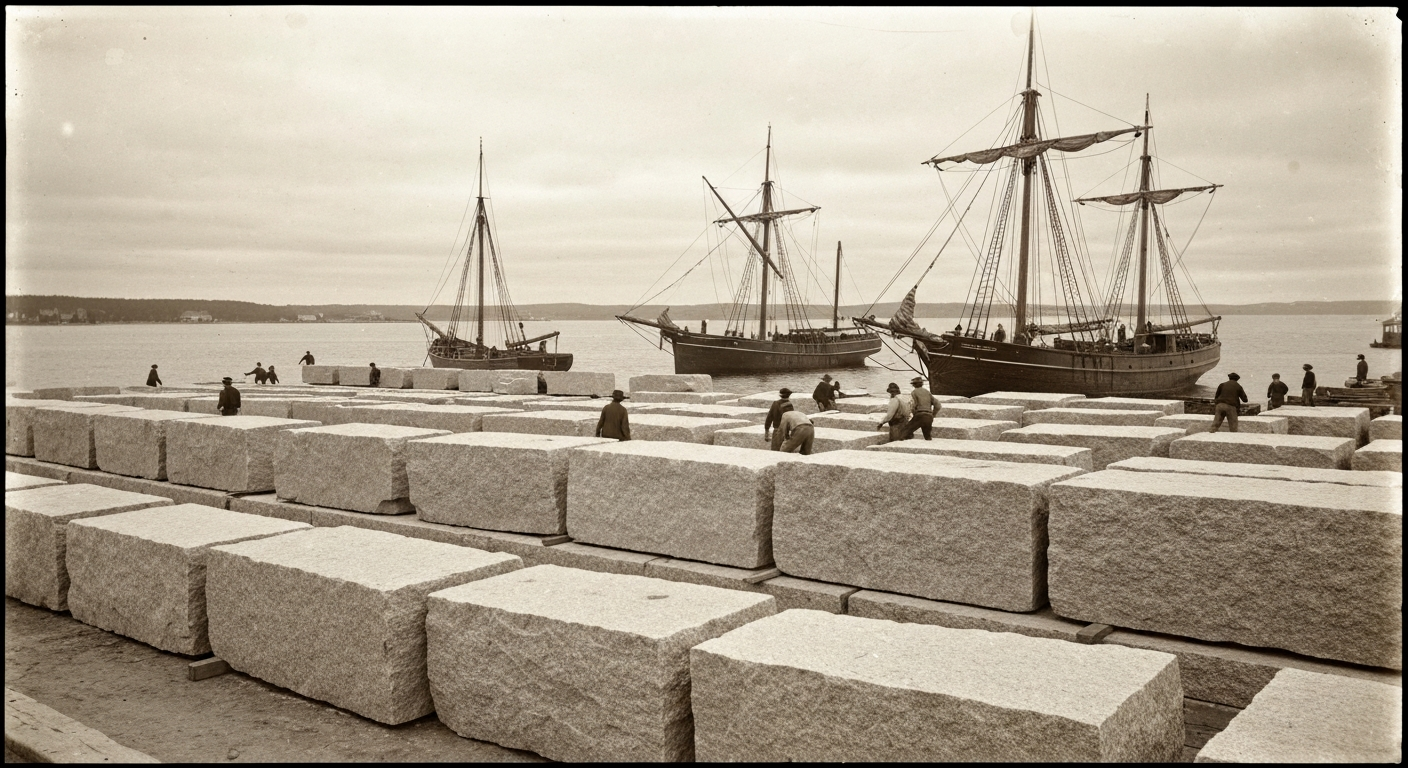
In the early days, massive granite blocks were hauled by ox cart to Rockport Harbor, where they were loaded onto schooners for transport down the coast. A single block could weigh ten tons or more. Loading these onto sailing vessels required specially built derricks and tide-dependent timing — the schooner would float in at high tide, the block would be positioned over the hold, and the vessel would settle beneath it as the tide went out.
The arrival of the railroad in the mid-1800s transformed the industry. Granite could now be shipped by rail to Boston, New York, and beyond. The Rockport Granite Company and other operators built their own spur lines directly from the quarries to the main rail line, dramatically increasing the volume of stone they could move.
What Rockport Granite Built
The stone from Rockport's quarries ended up in structures across the United States. Some of the most notable include:
- The Brooklyn Bridge — Cape Ann granite forms the massive anchorages at the base of the bridge towers on both the New York and Brooklyn sides. These anchorages hold the main cables that support the entire span.
- Boston's Custom House — the original federal Custom House in Boston, one of the most prominent government buildings of its era, was built with Rockport granite.
- The Charleston Navy Yard — granite seawalls and dry dock construction used Cape Ann stone for its resistance to saltwater.
- Boston seawalls and piers — much of Boston's 19th-century waterfront infrastructure was built with Rockport granite.
- Street paving blocks — millions of granite cobblestones from Rockport paved streets in Boston, New York, Philadelphia, and other growing cities.
If you walk through downtown Boston and look down at the cobblestones still visible in some alleys and historic areas, there is a good chance you are walking on Rockport granite.
The Decline of the Granite Industry
The granite industry in Rockport began to decline in the early 1900s. Several factors converged to end the boom:
- Reinforced concrete — the development of steel-reinforced concrete in the early 1900s gave builders a cheaper, faster, and more flexible alternative to cut stone for large structures.
- Changing architecture — the Beaux-Arts era of massive stone government buildings gave way to lighter, more modern construction styles.
- Labor costs — as wages rose and quarry work became harder to fill, the economics of hand-cut granite became difficult.
- Depleted quarries — some of the best stone had already been extracted, and deeper cuts were more expensive to reach.
By the 1920s, most of Rockport's quarries had closed. The last commercial quarrying operations in the area wound down by the mid-20th century. The industry that had defined Rockport for nearly a hundred years was over.
Halibut Point State Park
Today, the most visible reminder of Rockport's granite heritage is Halibut Point State Park. The park was built on the site of the Babson Farm Quarry, one of the last operating quarries on Cape Ann. The quarry pit is now filled with water, creating a striking landscape where visitors can see the sheer granite walls that quarrymen cut into the living rock.
The park's visitor center includes exhibits on the quarrying industry, with photographs and tools from the working era. A self-guided trail leads through the quarry and down to the rocky shoreline, where you can see how the granite ledge extends into the ocean — the same ledge that quarrymen followed inland to extract the stone.
What the Granite Means to Rockport Today
The granite industry shaped Rockport in ways that are still visible. The town's street layout, its harbor infrastructure, and even its population — many Rockport families trace their roots to the Irish, Finnish, and Italian quarry workers — all reflect the quarrying era.
For homebuyers exploring Rockport today, the granite legacy has practical implications. Many older homes in Rockport were built with granite foundations, granite sills, and granite walls — materials that have stood for 150 years and will likely stand for 150 more. The stone walls that crisscross the landscape are quarry remnants. Even the town's name, in a sense, is tied to the rock: "Rockport" — the port of rock.
Final Thoughts
The next time you walk across the granite ledges at Halibut Point or sit on a stone wall overlooking Rockport Harbor, take a moment to think about what that stone represents. It's not just a beautiful landscape. It's a monument to the thousands of men who spent their lives cutting, splitting, and hauling rock so that America could build its cities.
The quarries are quiet now. But the stone they produced is still standing — in bridges, buildings, and streets across the country. Rockport's granite is literally the foundation of America's infrastructure. And it all came from a small Cape Ann town that looked out over the Atlantic and saw, beneath its feet, one of the finest building stones in the world.