
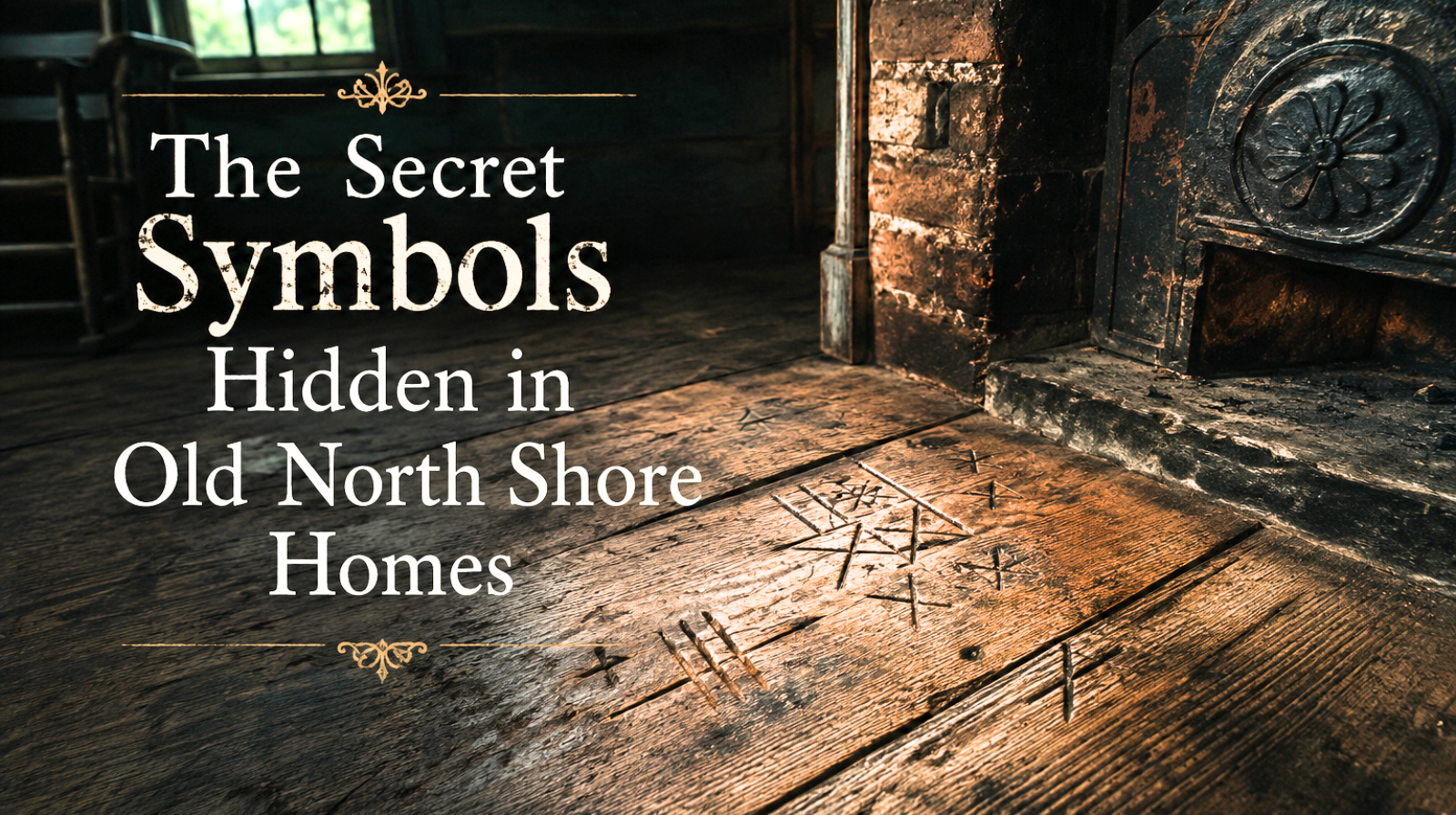
The Secret Symbols Hidden in Old North Shore Homes

The Short Version
Apotropaic marks are protective symbols carved into the timber of old North Shore homes — some dating to the 1600s. Early New Englanders etched daisy wheels, hexafoils, and "VV" marks near fireplaces, doorways, and attic beams to ward off witches, evil spirits, and misfortune. These symbols have been found in First Period homes across Ipswich, Salem, Gloucester, and other North Shore towns. They are not random scratches — they are deliberate rituals of protection that reveal how our colonial ancestors understood the world. If you own an antique North Shore home, you may have hidden symbols in your walls right now.
How Apotropaic Marks Were Believed to Keep Evil Spirits Away
For centuries, the ancient timber-framed homes of Boston's North Shore have guarded a silent, hidden history. Tucked away in the darkest corners of attics, etched into the oak lintels of massive fireplaces, and scratched into the thresholds of weathered doorways lie mysterious carvings that continue to fascinate homeowners, historians, and preservationists alike.
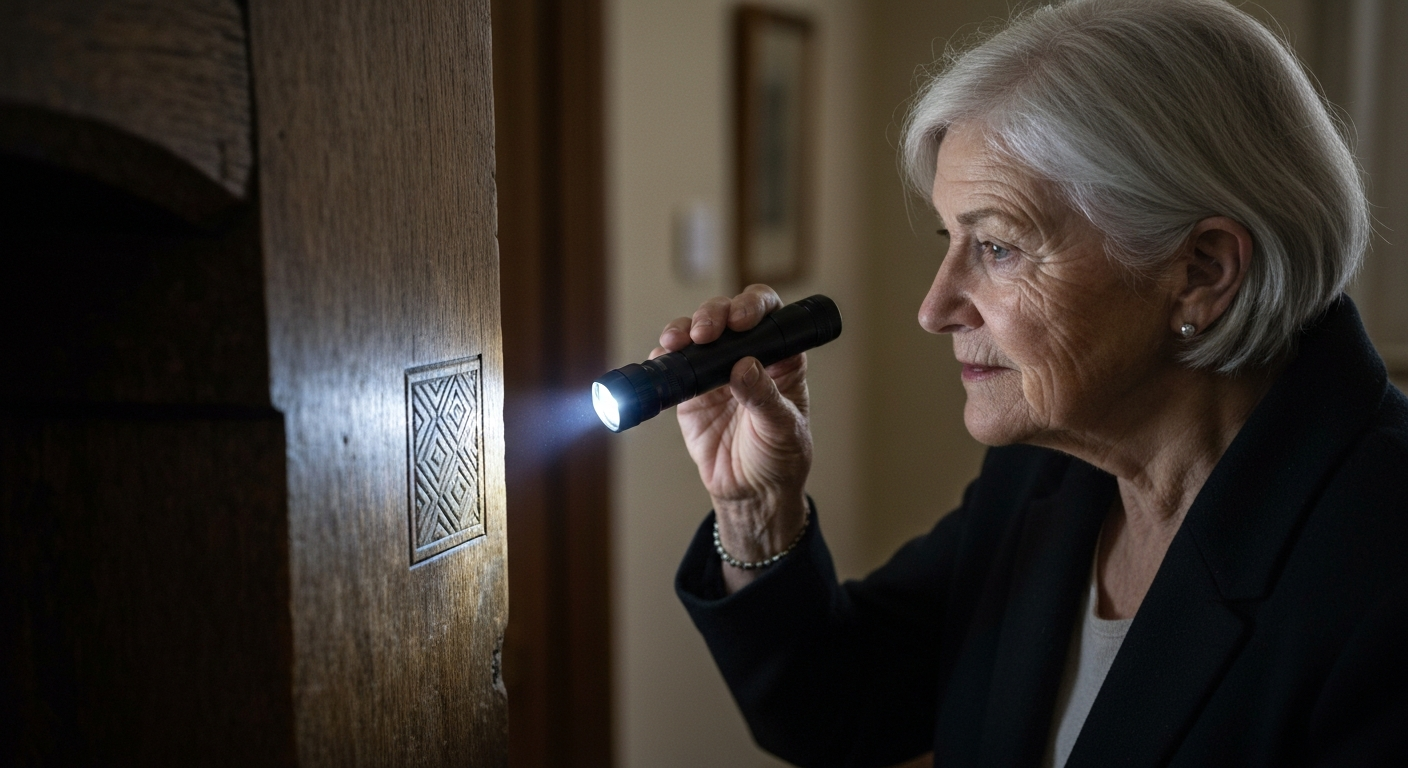
But these are no ordinary scratches. They are deliberate, centuries-old symbols left behind by early New Englanders to protect their families from forces they could not control. These are called apotropaic marks — from the Greek word meaning "to turn away" — and they represent one of the most intimate and overlooked chapters of North Shore architectural history.
What Are Apotropaic Marks?
Apotropaic marks are protective symbols carved, scratched, or burned into the structural timbers of old buildings. They were intended to ward off evil — witches, demons, curses, disease, and bad luck. The practice has deep roots in English folk tradition, brought to New England by early settlers who carried both their tools and their beliefs across the Atlantic.
In England, these marks are most commonly found in homes built between the 1500s and 1700s. On the North Shore, they appear in some of the oldest surviving structures — particularly First Period homes built between roughly 1620 and 1725. Towns like Ipswich, Salem, Gloucester, and Beverly have some of the highest concentrations of early colonial architecture in the country, making them prime territory for these hidden markings.
The Discovery in Ipswich
A few years ago, a homeowner in Ipswich was restoring an original fireplace in their 1690s First Period house. The plaster had crumbled. The mantel had been replaced sometime in the 1800s. Behind layers of paint and centuries of grime, the original oak lintel was still intact.
When they carefully cleaned the beam, they noticed a series of faint, deliberate scratches. Not the random wear of 300 years of use — but geometric patterns, carefully incised into the wood. A circle with petals radiating from the center. A series of overlapping "V" shapes. A crude cross.
Historic Fact: They weren't decoration. What looked like random scratches were actually centuries-old protective symbols carved by the people who built and lived in that home — a ritual practice brought from England and continued in the New World.
The Most Common Protective Symbols
While no comprehensive catalog exists for North Shore apotropaic marks, researchers in both England and New England have identified several recurring symbol types that appear in colonial-era homes:
The Daisy Wheel (Hexafoil)
The most commonly found apotropaic mark is the daisy wheel, also called a hexafoil. It is created by drawing a circle and then inscribing a series of interlocking arcs that create a six-petaled flower pattern. The symbol has ancient origins and appears in churches, homes, and barns across Europe dating back centuries. On the North Shore, daisy wheels are most often found near fireplaces — the largest opening in a colonial home and, in the folk imagination, a potential entry point for evil.
The Witch's V (VV Marks)
Another common symbol is the "VV" mark — two overlapping V shapes carved into a beam or lintel. This is believed to stand for Virgo Virginum (Virgin of Virgins), an invocation of the Virgin Mary for protection. Despite the name "witch mark," these symbols were not left by witches — they were carved to keep witches away. They are frequently found near doorways, windows, and fireplaces.
Concentric Circles
Some marks are simpler — a series of concentric circles or spirals scratched into wood or stone. These may have served as a form of spiritual "trap," believed to confuse or ensnare evil spirits by forcing them to follow the pattern endlessly rather than entering the home.
Crosses and X Marks
Simple crosses and X marks are also found in colonial homes. These are among the most universal protective symbols and may reflect both Christian and pre-Christian traditions. They often appear on threshold beams or near entry points.
Where to Look in an Old North Shore Home
If you own or are considering buying an antique North Shore home, apotropaic marks are most likely to be found in specific locations:
- Fireplace lintels and mantels — the chimney was the largest opening in a colonial home and considered the most vulnerable entry point for evil.
- Doorway thresholds and lintels — protecting the main entry to the home.
- Attic beams — the upper reaches of the home were associated with vulnerability to spiritual attack.
- Cellar beams — the dark, underground spaces of a home were naturally associated with fear and the unknown.
- Window surrounds — any opening to the outside world was a potential point of entry.
The Salem Witch Trials Connection
It is impossible to discuss protective symbols in colonial Massachusetts without acknowledging the Salem Witch Trials of 1692. The fear that gripped Essex County during that period was not isolated to Salem Village — it spread across the North Shore and left lasting marks, both psychological and physical, on the built environment.
While not every apotropaic mark in a North Shore home dates to the witch trials era, the climate of fear that produced the trials was the same climate that motivated homeowners to carve protective symbols into their walls. These marks are physical evidence of how deeply supernatural beliefs shaped daily life in colonial New England.
Local Connection: Ipswich, Salem, Gloucester, and Beverly all have surviving First Period homes where these marks have been documented or are likely to exist. If you are restoring an antique North Shore home, look carefully before sanding or replacing original timbers.
Why These Marks Matter to Homeowners Today
For buyers of historic North Shore homes, apotropaic marks are more than curiosities. They are evidence of the human stories embedded in the structure. A beam with a daisy wheel is a beam that someone cared about protecting. It is a direct, physical connection to the people who built the home and lived in it centuries ago.
If you discover these marks during a renovation, consider preserving them. Many homeowners photograph and document the symbols before covering them again. Some choose to leave them exposed as a conversation piece. Either way, they are part of the home's history and deserve the same respect as wide-plank floors or hand-hewn beams.
What to Do If You Find Protective Marks
If you discover apotropaic marks in your North Shore home:
- Photograph them before any further work is done on the beam or surface.
- Document the location — which beam, which room, and the orientation of the mark.
- Contact your local historical commission — many North Shore towns have active historical commissions that may be interested in documenting the find.
- Consider preservation — if possible, avoid sanding, painting over, or removing the marked timber.
- Do not assume the home is "haunted" — these marks were preventive, not reactive. They were carved by builders who wanted to keep bad things from entering, not by people who believed something was already there.
Final Thoughts
Boston's North Shore is filled with extraordinary historic homes. Within those walls, stories are waiting. We often think of history as something that happens on battlefields or in the halls of government. But the most intimate history is often found in the places where ordinary people lived their daily lives — the marks they left behind, the fears they carried, and the protections they built into the very bones of their homes.
The next time you walk through a 17th-century house in Ipswich or Salem, look closely at the beams above the fireplace. Run your fingers along the oak. You may find more than wood and age. You may find the quiet, centuries-old handwriting of someone who wanted to keep their family safe — in a world they could not fully explain.