What Is a Contingency in Real Estate? Massachusetts Buyer and Seller Contingencies Explained
Contingencies are your safety net in a real estate transaction. Here's what each one does, which ones you need, how to negotiate them, and when it's safe to waive them.
Kathleen Militello
REALTOR®, eXp Realty · North Shore Coastal Homes & Living
If you're buying or selling a home in Massachusetts, the word "contingency" will come up constantly. It's one of the most important concepts in real estate — and one of the most misunderstood.
A contingency is a condition built into your purchase agreement that must be met before the deal becomes fully binding. If the condition isn't met, the protected party can walk away without penalty. Contingencies are your escape hatch — the mechanism that lets you cancel a deal if something goes wrong.
What Is a Contingency, Exactly?
Think of a contingency as an "if-then" clause in your contract. If the home inspection reveals major problems, then I can cancel and get my deposit back. If my mortgage isn't approved, then I can walk away without losing my earnest money.
Without contingencies, you'd be locked into buying a home no matter what — even if the inspection found a crumbling foundation, the appraisal came in $100,000 low, or your loan was denied. Contingencies give you the right to investigate, verify, and confirm before you're fully committed.
The Earnest Money Connection
Contingencies and earnest money are directly linked. Your earnest money deposit — typically $1,000 at the offer and 5% of the purchase price at the P&S — is at risk if you default on the contract without a valid contingency. If you have a contingency and it's not met, you get your deposit back. If you waive contingencies and then can't perform, you could forfeit the entire deposit.
The Main Contingencies Every North Shore Buyer Should Know
1. Home Inspection Contingency
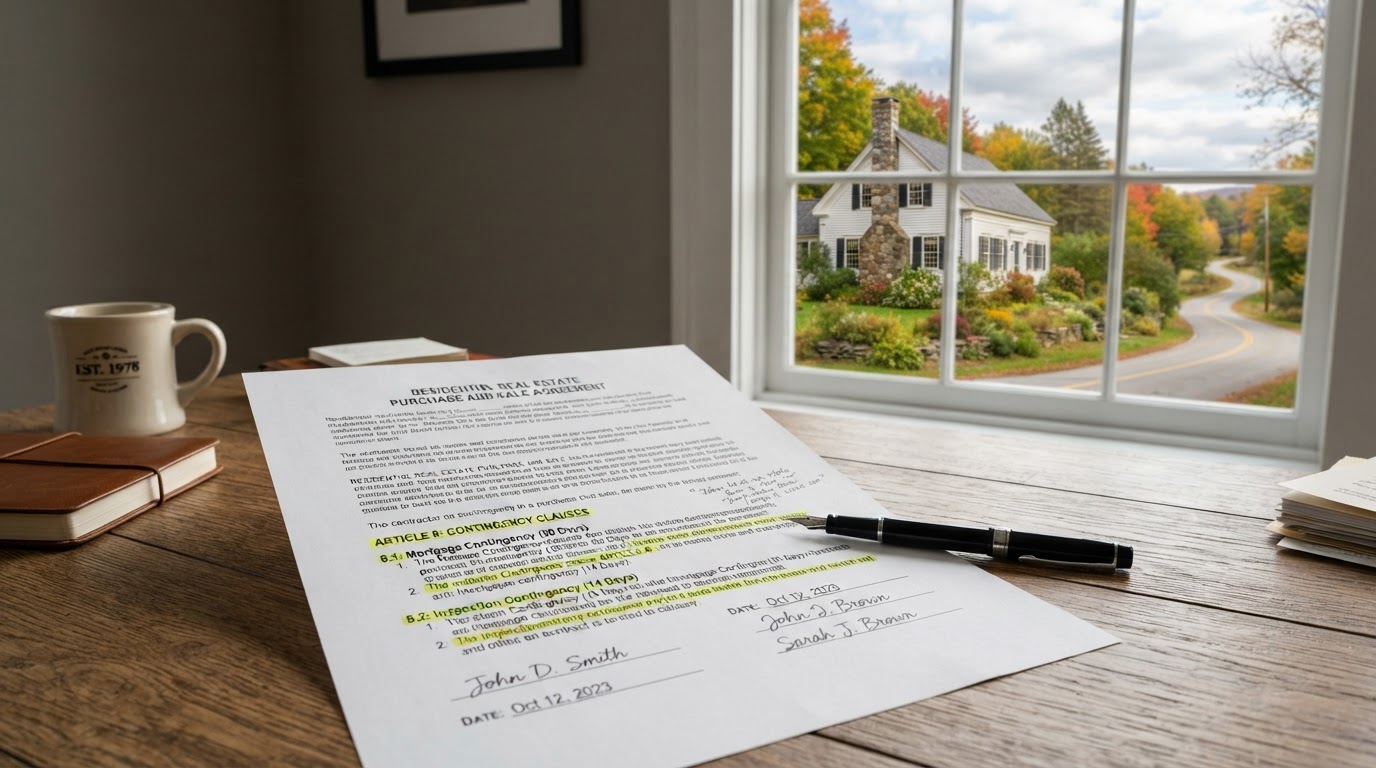
Gives you the right to inspect the property and cancel or renegotiate based on the findings.
The most important contingency for most buyers. You typically have 7–10 days after the P&S to complete a professional home inspection. If the inspection reveals major defects — structural issues, a failed septic system, a bad roof — you can ask the seller to make repairs, reduce the price, or cancel the deal and recover your earnest money.
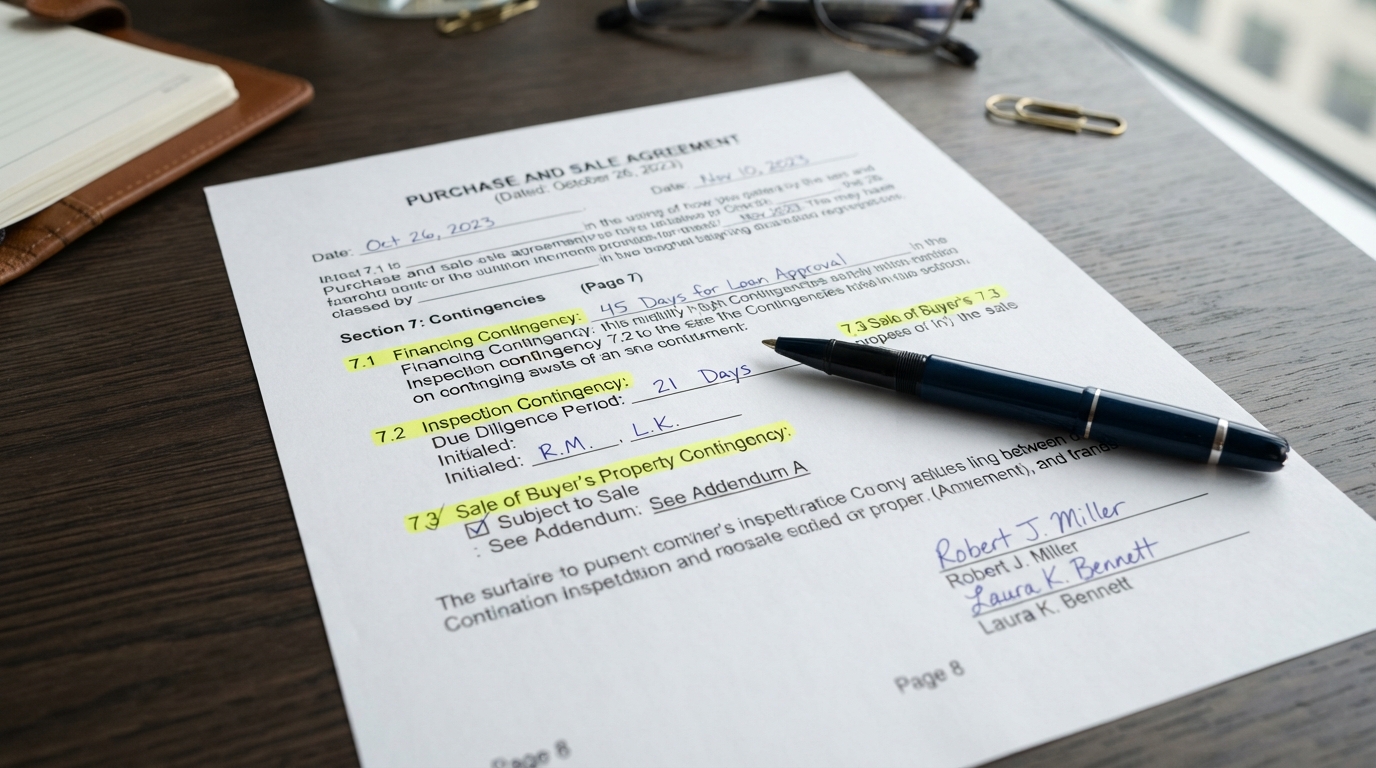
2. Financing (Mortgage) Contingency
Protects you if your mortgage is denied or the terms change significantly.
If your loan is denied — or the rate and terms change substantially from what was expected — you can cancel the contract and get your deposit back. The financing contingency typically runs until you receive a loan commitment from your lender, usually 21–30 days after the P&S is signed. Without this contingency, you could lose your deposit if your financing falls through.
3. Appraisal Contingency
Protects you if the home appraises for less than the purchase price.
If the appraisal comes in below the agreed-upon price, your lender will only finance based on the appraised value. The appraisal contingency lets you cancel and recover your deposit if you can't reach an agreement with the seller on the price gap. Without it, you'd be obligated to make up the difference in cash — or default and lose your deposit.
4. Home Sale Contingency
Makes your purchase contingent on selling your current home first.
If you need the proceeds from selling your current home to buy the next one, this contingency lets you cancel if your home doesn't sell within a specified period. Sellers are often wary of this contingency because it creates uncertainty — they may include a kick-out clause that lets them accept a better offer if one comes in.
5. Radon and Water Quality Contingency
Specifically for North Shore homes with private wells or basements.
Many North Shore homes — especially in rural communities like Ipswich, Essex, Boxford, and Georgetown — have private wells and high radon potential. A radon/water contingency gives you the right to test for radon in air and water, and for water quality (bacteria, nitrates, arsenic, uranium). If results exceed acceptable thresholds, you can require treatment, renegotiate, or cancel.
Contingencies from the Seller's Perspective

Contingencies aren't just for buyers. Sellers have their own concerns:
- Fewer contingencies = stronger offer: In a multiple-offer situation, sellers often prefer buyers with fewer contingencies. A buyer who waives the financing and inspection contingencies looks more committed — but takes on more risk.
- Kick-out clauses: If a buyer includes a home sale contingency, the seller may insist on a kick-out clause that lets them continue marketing the home and accept a better offer if one comes in.
- Contingency timelines: Sellers want short contingency periods so the deal moves quickly. Buyers want more time. This is a negotiation point.
- As-is sales: Some sellers list "as-is," meaning they won't make repairs regardless of inspection findings. You can still inspect — but the seller won't fix anything. The inspection contingency still lets you walk if the findings are unacceptable.
When Is It Safe to Waive Contingencies?
In hot markets, buyers sometimes waive contingencies to make their offers more competitive. This is a calculated risk. Here's how I think about it:
Sometimes Reasonable to Waive
- • Financing contingency, if you're pre-approved with a strong lender and have significant cash reserves
- • Appraisal contingency, if you have extra cash to cover a potential gap and the price is supported by recent comps
- • Home sale contingency, if your current home is already under agreement
Rarely Safe to Waive
- • Home inspection contingency on an older home (100+ years old is common on the North Shore)
- • Financing contingency if your down payment is less than 20% or your credit is borderline
- • Radon/water contingency on a property with a private well
- • Any contingency if you're a first-time buyer unfamiliar with the risks
The Massachusetts inspection law changed
Massachusetts now prohibits forced inspection waivers — sellers can no longer require buyers to waive their inspection rights. However, buyers can still voluntarily choose to make their offer non-contingent on inspection results. The law protects your right to inspect; it doesn't force you to use the results as a contingency. Know the difference.
How to Negotiate Contingencies in Massachusetts
Every contingency is negotiable — the type, the timeline, and the conditions. Here's what I recommend:
- Keep the inspection contingency — always. On North Shore homes, especially older ones, the inspection is non-negotiable. You can shorten the timeline to 5 days to show the seller you're moving fast.
- Get pre-approved before making an offer. A strong pre-approval letter lets you keep the financing contingency with confidence — and signals to the seller that your loan will likely be approved.
- Negotiate the appraisal gap. If you're worried about a low appraisal, keep the contingency. If you have cash reserves and the comps support the price, you might waive it — but know the risk.
- Consider a pre-offer inspection. If you want to make a non-contingent offer in a competitive situation, hire an inspector before making the offer. You'll know the home's condition and can waive the contingency with confidence.
- Use contingency timelines strategically. Shorter timelines make your offer stronger. A 5-day inspection window is more attractive than a 10-day window — but make sure you can actually schedule and complete the inspection in that time.
Not Sure Which Contingencies You Need?
Every transaction is different. I'll help you understand which contingencies protect you, which you can safely waive, and how to structure your offer to win without taking on unnecessary risk.