Local History
The Gloucester Sea Serpent: Did a Monster Really Swim Through Gloucester Harbor in 1817?
Kathleen Militello · Gloucester & Cape Ann · Published October 18, 2026 · Updated October 18, 2026 · 9 min read
Local History
Kathleen Militello · Gloucester & Cape Ann · Published October 18, 2026 · Updated October 18, 2026 · 9 min read
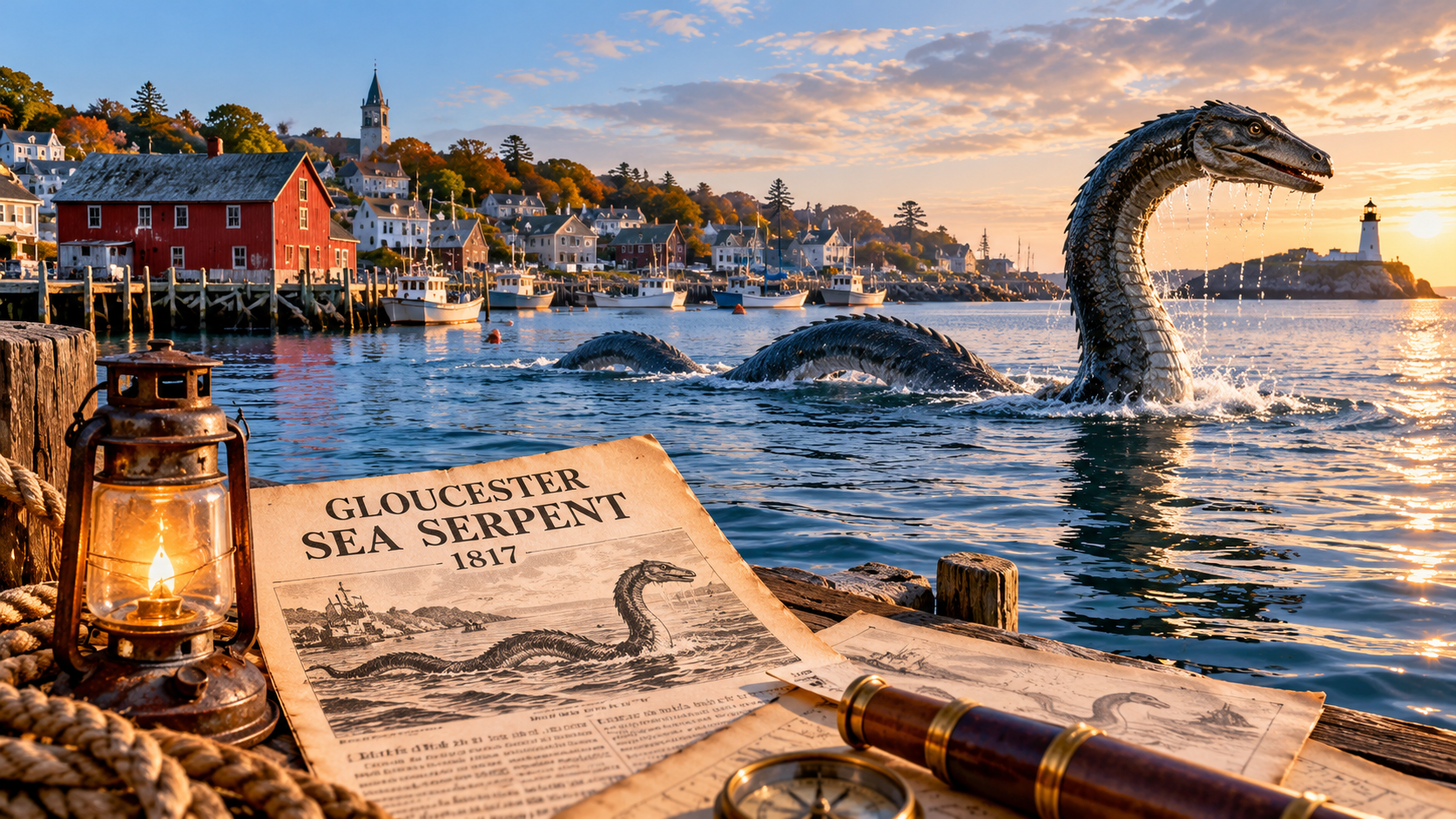
Picture a calm August day in 1817 on Gloucester Harbor. A group of fishermen out on the water spots something enormous moving through the waves, a dark form far longer than any whale they have ever seen. Within days the sighting is on everyone's lips. Hundreds of curious spectators gather on the shore, the story spreads through the respectable publications of the day, and a learned scientific society in Boston appoints a committee to investigate. Nearly two centuries later, no one can say for certain what those fishermen saw. This is the story of the Gloucester sea serpent: what the witnesses described, how science took the reports seriously, and what modern researchers think it really was.
Key Takeaways
In August 1817, Gloucester fishermen reported an enormous serpent-like creature in the harbor, described as roughly 40 to 100 feet long with a head some likened to a horse and others to a turtle.
Indigenous people of Cape Ann had told settlers about a sea serpent long before, and one of the earliest recorded sightings near Cape Ann came from colonist John Josselyn in 1638.
The Linnaean Society of New England appointed a committee on August 18, 1817 that gathered sworn testimony, including ten depositions from men described as of unblemished character, and produced a genuine scientific report.
A three-foot snake found on the beach by Gorham Norwood on September 27, 1817 was declared the serpent's offspring and given the new scientific name Scoliophis atlanticus.
The mystery was never proven. Modern researchers point to seals, sharks, or whales behind the large sightings, and a common snake with an unusual spine behind the small one.
The sightings begin
In August 1817, a group of fishermen in Gloucester reportedly saw an enormous serpent-like creature moving through the water. Different witnesses described it differently, which is part of what makes the record so fascinating. The creature was said to be roughly 40 to 100 feet long, with a head some compared to a horse and others to a turtle. Its body rose and fell in humps or joints that reminded witnesses of a line of barrels, and it moved with an undulating, up-and-down swimming motion rather than side to side.
The reports kept coming through that August and into 1818 and 1819, around Gloucester and the rest of Cape Ann, and as far south as Nahant Bay. Witnesses said the creature would swim in circles, sun itself on the surface of the water, and feed near schools of herring, the fish that have drawn both fishermen and wildlife to these waters for centuries.
The sightings drew hundreds of curious spectators to the shore, and the story spread through the respectable publications of the day. What began as a strange report from a small fishing town became one of the most talked-about stories in New England, and a story that big tends to attract the attention of science.
Indigenous tradition and an early record
The sea serpent did not begin with the fishermen of 1817. The Indigenous people of Cape Ann had told settlers about a sea serpent long before Gloucester Harbor made the report famous. The story, in other words, was older than the town itself, part of the deep history of this coastline.
One of the earliest modern recorded sightings came nearly two centuries earlier, in 1638, near Cape Ann. It was recorded by colonist John Josselyn, who set down what had been seen along this coast. That early record matters: when the fishermen of 1817 pointed at the water, they were pointing at something people had been talking about on the North Shore for generations.
The Linnaean Society of New England
On August 18, 1817, the Linnaean Society of New England in Boston appointed a committee to collect evidence about the sightings. The committee included U.S. district court judge John Davis, Dr. Jacob Bigelow, and Francis C. Gray, Esq. These were serious investigators, and they treated the reports as a question worth studying rather than a story to dismiss.
The committee gathered sworn testimony from the witnesses, including ten sworn depositions from men described as being of unblemished character. In an era without photographs or video, sworn statements were the strongest evidence available, and the committee took them seriously.
The result was a genuine scientific report, one that recorded exactly what the witnesses said and treated the sea-serpent question with the same care as any other matter of natural history. It stands as one of the earliest serious attempts in this country to apply science to a strange claim.
Gorham Norwood's find
On September 27, 1817, Gloucester resident Gorham Norwood discovered a small snake on the beach, only about three feet long, and killed it. What caught everyone's attention was its back. The little snake had a strange, undulating spine, a body line that seemed to echo the humps people described on the great creature offshore.
Because of the sea-serpent sightings, the snake was brought to the Linnaean Society. The society declared it the serpent's offspring and introduced a new scientific genus for it, giving the creature the name Scoliophis atlanticus. It was a remarkable step: a small beach snake had been written into the official scientific record of its day.
The naming felt like a breakthrough, a physical trophy for the story. As later researchers would come to see, the little snake may have been nothing more exotic than a common local snake with an unusual appearance.
Natural explanations for a strange story
The mystery was never proven, and modern researchers, including skeptical investigators, have offered natural explanations for the 1817 reports. The large sightings may have been misidentifications of known animals: a school of seals moving through the water in a line, a large shark cruising near the surface, or a whale surfacing and diving. Seen at a distance, on moving water, with imagination and excitement running high, any of these could read as a hundred-foot serpent with barrel-like humps.
The small “offspring” snake is easier to explain. It was likely a common local snake with a spinal deformity or an unusual appearance, a single ordinary animal that arrived at the wrong moment, when everyone was looking for a sea serpent's young.
None of this makes the witnesses foolish. They described what they saw honestly, and the gentlemen who recorded their words treated them with respect. The honest conclusion is simple: whatever it was, the 1817 Gloucester sea serpent remains one of the most scientifically discussed and respected sea-serpent encounters in history.
Gloucester and Cape Ann now
Gloucester Harbor is still full of life and history. The same waters that carried the 1817 stories still carry fishing boats, sailors, and enough wildlife to keep the view interesting year round, and the old tales travel easily from one dock to the next. Cape Ann, from Gloucester to Rockport and Essex, has a way of holding onto its stories, and this one is retold wherever people talk about the sea.
Whether you are buying, selling, or just exploring Cape Ann, knowing the towns behind the stories matters. I have worked on Boston's Coastal North Shore since 2003 as a Realtor® with eXp Realty, and Gloucester has been part of my market the whole way. If you are curious about this corner of the coast, about a home here, or about what a move to the sea would look like, call me at (978) 500-1480 or book a conversation. No pressure, just straight talk about what makes sense for you.
The Gloucester sea serpent may never be explained to everyone's satisfaction, and that is part of its charm. Two centuries later, it stands as proof that a strange story, told honestly, can move a town, the newspapers, and science itself. Warmly, Kathleen Militello, Realtor®, eXp Realty.
Ask Kathleen
Straight answers to the questions this season keeps bringing up, from the article above.
No. The mystery was never proven. A committee of the Linnaean Society of New England gathered sworn testimony and produced a genuine scientific report, but no one has ever confirmed what the 1817 witnesses saw.
Witnesses described a serpent-like creature roughly 40 to 100 feet long, with a head some compared to a horse and others to a turtle, a body with humps or joints like a line of barrels, and an undulating, up-and-down swimming motion.
Its committee, appointed on August 18, 1817, collected sworn testimony including ten depositions from men described as being of unblemished character and produced a genuine scientific report. The society also declared a small snake found on the beach in Gloucester the serpent's offspring and gave it the new scientific name Scoliophis atlanticus.
Modern researchers think the large sightings were likely misidentifications of known animals, such as a school of seals, a large shark, or a whale, amplified by imagination and excitement. The three-foot snake was likely a common local snake with a spinal deformity or unusual appearance.
No confirmed sea serpent has been reported in Gloucester Harbor since, and the 1817 mystery was never solved. The harbor is still full of life, and seals and whales are among the animals researchers believe excited witnesses back in 1817, so a long look at the water on a quiet day is always worthwhile.

Written by
Kathleen Militello, Realtor®
The Militello Team · AI Certified Agent™ · Certified Negotiation Specialist™ · eXp Realty
This article retells the documented 1817 Gloucester sea-serpent sightings as local history. It is not a claim that any sea serpent was proven real. Kathleen Militello is a Realtor® with eXp Realty, MA Salesperson License 9053343. All real estate services are offered in accordance with the Fair Housing Act and Equal Housing Opportunity.
From the page to the porch
A note can only tell you so much. Let Kathleen take you through the towns, the streets, and the options that actually fit.