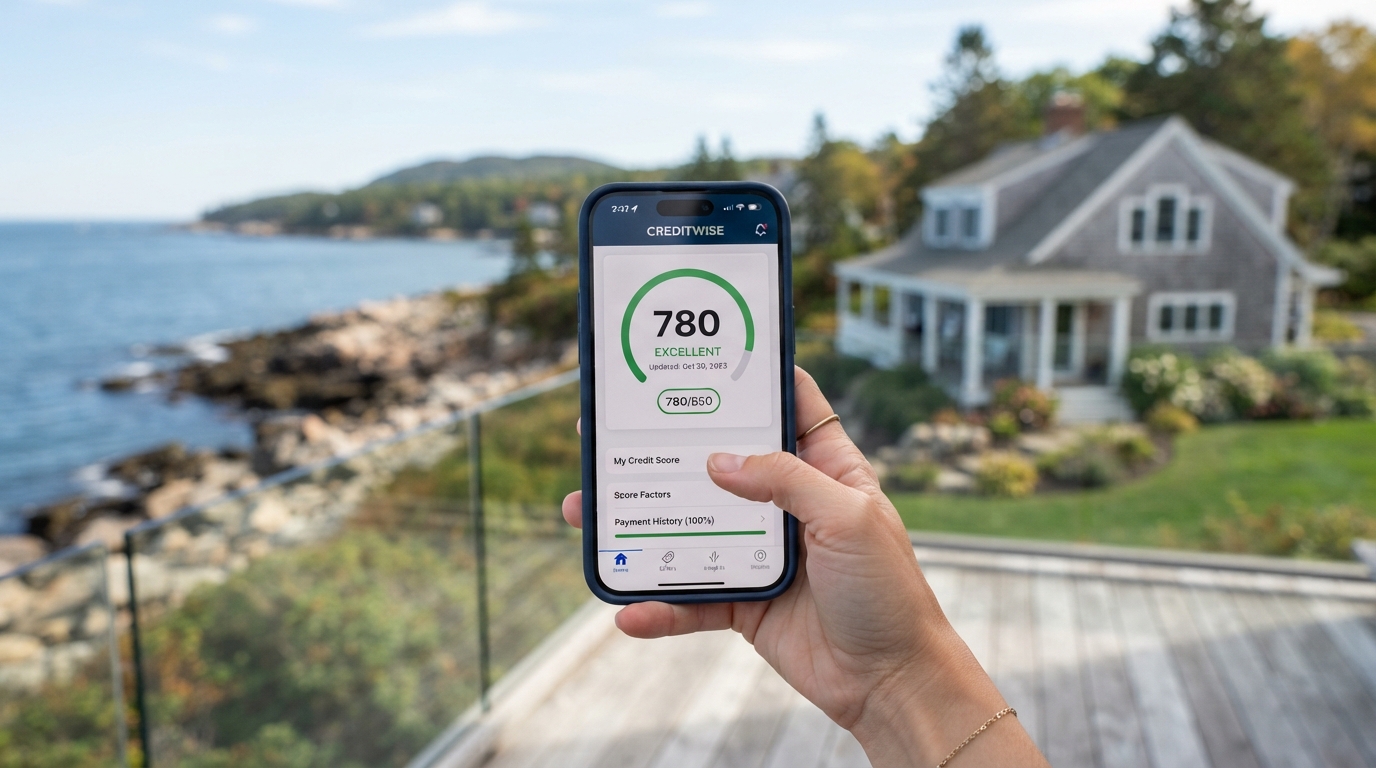
If you are thinking about buying a home on Boston's North Shore, your credit score is one of the first things a lender will look at. It determines whether you qualify, what interest rate you pay, and how much your monthly payment will be. A strong score can save you thousands of dollars over the life of your loan. A weaker score does not necessarily disqualify you, but it changes your options.
The Minimum Credit Score by Loan Type
There is no single "minimum credit score to buy a house." The number depends on which type of loan you are using. Here is what North Shore buyers need to know about each option in 2026.
Conventional Loan
Minimum FICO: 620. Requires 3% to 5% down. Private mortgage insurance (PMI) required below 20% equity. Offered by most banks and mortgage lenders on the North Shore.
FHA Loan
Minimum FICO: 580 with 3.5% down, or 500 with 10% down. Backed by the Federal Housing Administration. Mortgage insurance required for the life of the loan in most cases.
VA Loan
No official minimum, but most lenders want 580 to 620. Zero down payment. No PMI. Available to active-duty service members, veterans, and eligible spouses.
Jumbo Loan
Minimum FICO: 680 to 700+. Required for loans above the conforming limit ($806,500 in Essex County for 2026). Common for North Shore coastal and luxury properties.
How Your Credit Score Affects Your Interest Rate
Your credit score does not just determine whether you qualify. It directly affects the interest rate a lender offers you. The higher your score, the lower your rate. The lower your rate, the less you pay every month and over the life of the loan.
Here is a practical example. Say you are buying a $500,000 home on the North Shore with 20% down. That is a $400,000 loan. The difference between a 680 score and a 740 score could mean an interest rate that is 0.25% to 0.5% lower.
At 680 score (example: 6.75% rate):
Monthly payment: ~$2,594. Total interest over 30 years: ~$533,840.
At 740 score (example: 6.45% rate):
Monthly payment: ~$2,516. Total interest over 30 years: ~$505,760.
Difference: ~$78/month and ~$28,080 in interest saved over the life of the loan.
These are illustrative numbers, not a rate quote. Actual rates change daily and depend on your full financial profile. But the principle holds: improving your credit score before you buy can save you real money. For a deeper look at how mortgage insurance factors in, see our PMI guide for North Shore buyers.
What Credit Score Range Are You In?
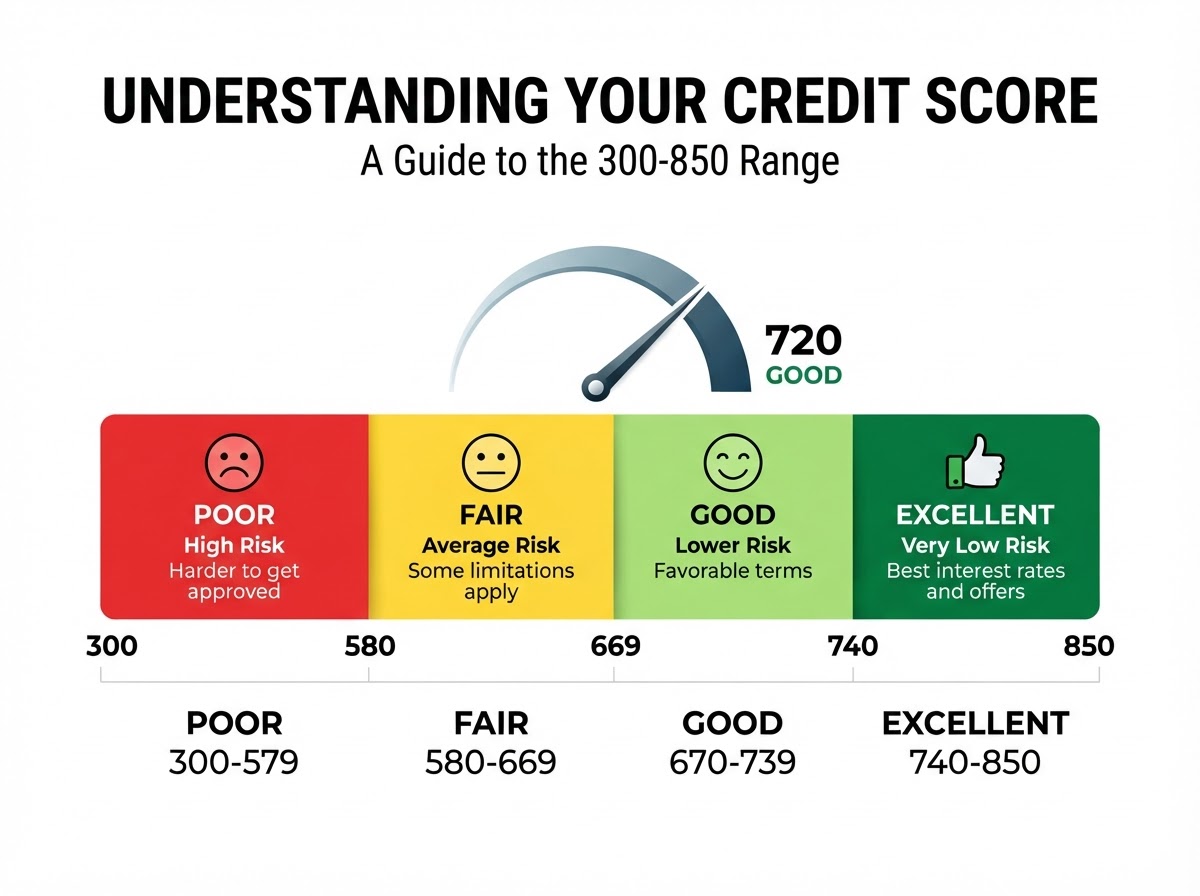
FICO scores range from 300 to 850. Here is what each range means for a North Shore home buyer:
Below 580: Poor
Conventional loans are unlikely. FHA is possible with 10% down. Focus on credit repair before applying. Some lenders specialize in credit-challenged borrowers, but rates will be high.
580 to 669: Fair
FHA loans are your strongest option. Conventional is possible at 620+ but with higher rates and PMI. Improving to the 670+ range will meaningfully expand your options and lower your costs.
670 to 739: Good
You qualify for conventional loans with reasonable rates. You are in the range where most North Shore buyers land. Pushing above 740 unlocks the best available rates.
740 and Above: Excellent
You get the best rates lenders offer. You will have the most loan options, the lowest mortgage insurance costs, and the strongest negotiating position. Jumbo loans are accessible at 700+.
Which Lenders Use Which Score?
This is where many buyers get confused. The score you see on your credit card app or a free monitoring service is often not the same score your mortgage lender sees.
Mortgage lenders use FICO Scores 2, 4, and 5 — older FICO models specifically designed for mortgage lending. They pull all three major credit bureaus (Equifax, Experian, TransUnion) and typically use your middle score for qualification. If you are buying with a partner, lenders use the lowest middle score between the two of you.
Free apps often show VantageScore 3.0, which uses a different scoring model. VantageScore and FICO can differ by 20 to 60 points. Do not be surprised if your lender's number is lower than what your app shows. The best way to know your real mortgage score is to get pre-approved — the lender will pull your actual mortgage FICO scores.

How to Improve Your Credit Score Before Buying
If your score is below 700, even a 20 to 40 point improvement can make a real difference in your rate. Here are the most effective steps, ranked by impact:
- 1.
Pay down credit card balances
Credit utilization (how much of your available credit you are using) is the second biggest factor in your score. Keep balances below 30% of your limit, ideally below 10%. Paying down cards can boost your score within 30 days.
- 2.
Do not open new credit accounts
Every new application creates a hard inquiry that can drop your score 2 to 5 points. Avoid new credit cards, auto loans, or store cards for at least 90 days before applying for a mortgage.
- 3.
Dispute errors on your credit report
Pull your free reports from annualcreditreport.com and check for errors — wrong balances, accounts that are not yours, or outdated negative items. Disputing errors can take 30 to 60 days but can meaningfully raise your score.
- 4.
Keep old accounts open
Closing an old credit card shortens your credit history and reduces your available credit, both of which can lower your score. Keep accounts open even if you are not using them, but pay them off.
- 5.
Make every payment on time
Payment history is 35% of your FICO score — the single biggest factor. One late payment can drop your score 60 to 100 points. Set up autopay on every account at least the minimum payment.
- 6.
Ask for a credit limit increase
If you have a good payment history, ask your card issuer for a credit limit increase. This lowers your utilization ratio without requiring you to pay down debt. Just do not use the extra credit.
Should You Wait to Improve Your Score or Buy Now?
This depends on your current score, how quickly you can improve it, and what the market is doing. If your score is 680 or above, you likely qualify for a conventional loan at a reasonable rate. Waiting to push above 740 could save you money, but you also risk rising home prices and changing rates.
If your score is below 620, improving it before buying is almost always the right move. A 60 to 90 day delay to raise your score from 600 to 660 could expand your loan options, reduce your rate, and eliminate the need for FHA mortgage insurance for the life of the loan.
The best way to decide is to talk to a lender early. A pre-approval conversation does not commit you to anything, and it gives you your actual mortgage FICO scores so you know exactly where you stand. Start with our pre-approval page to connect with a lender who works with North Shore buyers.
What If You Have a Lower Score and Need to Buy Now?
Life does not always wait for a perfect credit score. Job relocations, growing families, or changing circumstances sometimes mean you need to buy now. Here is what to know:
- FHA loans remain the most accessible path for scores between 580 and 620. The 3.5% down payment is lower than conventional, but mortgage insurance stays for the life of the loan.
- VA loans are an excellent option for veterans and active-duty military. No down payment, no PMI, and competitive rates even at lower credit scores.
- Manual underwriting is available through some lenders for borrowers whose scores do not meet automated approval but have strong income and employment history.
- A larger down payment can offset a lower score in some cases. Putting 20% down eliminates PMI on conventional loans and signals lower risk to the lender.
Kathleen's Take
I talk to North Shore buyers every week who assume their credit score disqualifies them before they have even spoken to a lender. That is rarely the full picture. The number you see on your phone is probably not the number your mortgage lender sees, and there are loan programs designed specifically for buyers in the 580 to 660 range.
My advice is always the same: get pre-approved early, even if you are months away from buying. You will learn your actual mortgage scores, understand what you qualify for, and get a roadmap for improvement if needed. A 60-day delay to raise your score 30 points could save you $30,000 over the life of your loan. That is worth waiting for.
If you are not sure where you stand, I can connect you with lenders who work with North Shore buyers across the full credit spectrum. No pressure, no obligation — just real numbers so you can make a smart decision.
Not Sure Where Your Credit Stands?
Get pre-approved to see your actual mortgage FICO scores and understand your buying power on the North Shore.
Call or Text: 978-500-1480Related Reading
First-Time Home Buyers
Private Mortgage Insurance (PMI) Explained: When It Applies and How to Get Rid of It
Buyer Guides
The Complete Guide to Closing Costs on Boston's North Shore
First-Time Home Buyers
12 Mistakes First-Time Home Buyers Make on the North Shore
Buyer & Seller Tips
The 2026 North Shore Home Buyer's Checklist: What to Know Before You Make an Offer
Questions People Actually Ask About Credit Scores and Mortgages
What credit score do you need to buy a house in Massachusetts?
For a conventional loan, most lenders on the North Shore want a minimum FICO score of 620. FHA loans accept scores as low as 580 with 3.5% down, or 500 with 10% down. VA loans have no official minimum, but most lenders want at least 580 to 620.
Can I buy a house on the North Shore with a 620 credit score?
Yes. A 620 score qualifies you for a conventional loan, but you will pay a higher interest rate than someone with 740 or above. You may also need a larger down payment to offset the risk. FHA financing is another option at this score level.
What credit score gets the best mortgage rate in 2026?
Most lenders offer their best rates to borrowers with FICO scores of 740 or higher. Above 740, the rate improvements are minimal. The biggest rate jumps happen between 620 and 740, so improving your score within that range can save you thousands.
How much does my credit score affect my monthly payment?
On a $500,000 North Shore home with 20% down, the difference between a 680 and a 740 score could mean 0.25% to 0.5% lower interest rate. Over 30 years, that adds up to tens of thousands of dollars in interest savings.
Can I get pre-approved with a lower credit score?
Yes. Pre-approval is available through FHA, VA, and some conventional lenders with scores in the 580 to 620 range. However, your interest rate and mortgage insurance costs will be higher. Talk to a lender about your specific situation before ruling yourself out.
Should I improve my credit score before buying a North Shore home?
If your score is below 700, even a 20-point improvement can meaningfully reduce your rate. Pay down credit card balances, avoid new credit applications, and dispute any errors on your report. A 60 to 90 day delay could save you money for the life of the loan.
Do all three credit bureaus need to show the same score?
No. Lenders pull all three major bureaus (Equifax, Experian, TransUnion) and typically use the middle score for qualification. If two borrowers are on the loan, lenders use the lowest middle score between the two applicants.
What is the difference between FICO and VantageScore for mortgages?
Most mortgage lenders use FICO scores, specifically FICO Score 2, 4, and 5 models. VantageScore is used by free monitoring services but is rarely used for mortgage qualification. Your free credit score app may show a different number than what your lender sees.

Kathleen Militello
REALTOR® · eXp Realty · Licensed Since 2003 · AI Certified Agent™ · Certified Negotiation Specialist™