
Downsizing on the North Shore
Swimming Pools, Happy Hours, and No More Yard Work: Is Retirement Living on the North Shore Worth It?
Kathleen Militello · Published October 20, 2026 · Updated October 2026 · 11 min read
Downsizing on the North Shore
Kathleen Militello · Published October 20, 2026 · Updated October 2026 · 11 min read
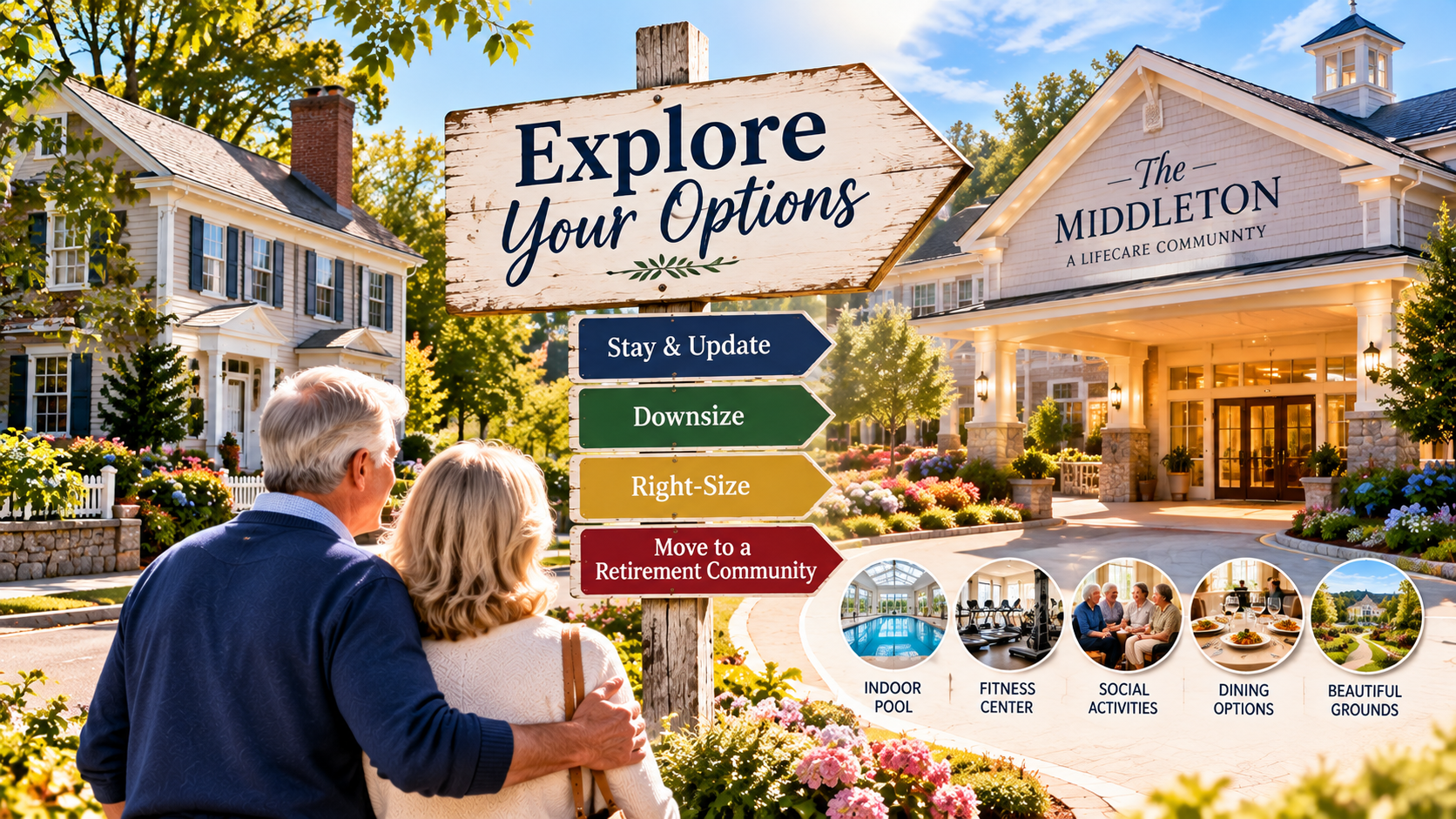
Imagine waking up on a cold January morning in Massachusetts without a driveway to shovel. Instead of scraping ice, you head downstairs for a swim, meet a few neighbors for coffee, and decide between an afternoon lecture and a group heading into town for lunch. Later there might be live music, a movie, or a happy hour a short distance from your door, and none of it requires you to cook, clean the gutters, arrange for snow removal, or worry about the lawn. It sounds a little like living at a resort, and some retirement communities north of Boston really do offer much of it. Before you put your house on the market, though, there is an important question worth asking: is this lifestyle really worth what it costs? The answer might surprise you.
Key Takeaways
Retirement living today includes independent living, assisted living, memory care, and life plan communities, and understanding the difference matters before you compare any prices.
Amenities like a pool, dining, and activities are real draws, but what is included in the monthly fee varies, so it deserves a written answer before you commit.
Assisted living in Massachusetts is expensive: the state's median monthly range for traditional assisted living is roughly $3,655 to $8,036, and memory care costs more.
Compare the full cost of staying home, including taxes, insurance, upkeep, repairs, and services, against what a community really costs over time.
A smaller home can be a middle path that keeps your independence, and the right answer depends on the lifestyle you want, so compare the lifestyle as carefully as the price.
More than you might picture
When people hear the words retirement community, they sometimes picture a quiet building where residents sit around watching television. That picture does not reflect the range of choices available today, and understanding the difference between them matters before you start comparing communities.
Some communities offer independent apartments and cottages designed for active adults who want fewer household responsibilities and more opportunities to enjoy themselves. Others provide assisted living, where residents receive help with everyday activities such as bathing, dressing, or managing medications. Memory care communities provide specialized support for people living with dementia. And life plan communities may offer independent living along with access to additional levels of care if a resident's needs change.
These are very different arrangements. You do not need to need assistance with daily living to consider moving into an independent living community. Sometimes the attraction is simply wanting to spend less time taking care of a house and more time enjoying life.
Staying active through a North Shore winter
Living on the North Shore means enjoying four beautiful seasons. It also means winter can make staying active more challenging, which is where a community with the right amenities changes things. Imagine being able to swim indoors in February without driving across town to a gym.
At Brooksby Village in Peabody, residents have access to an aquatics facility, a fitness center, wellness classes, and walking paths. Edgewood in North Andover also offers an indoor heated swimming pool and fitness facilities, along with spaces for recreation, learning, and social gatherings. Nichols Village in Groveland is another independent living community worth exploring for its wellness amenities and organized activities.
Before choosing any community, I would ask how the amenities actually work. Is the pool open throughout the day? Are there water exercise classes? Is fitness instruction included, or are there additional charges? A swimming pool in a brochure is one thing. Being able to use it regularly and comfortably is another.
Dining without the cooking
For some people, this could be one of the greatest benefits of retirement living. Think about how much time goes into planning meals, shopping for groceries, cooking, and cleaning up afterward. Now imagine having a restaurant or dining room right in your community.
At Brooksby Village, residents can choose among several dining venues, including the Cider House Pub, Harvest Grill, and Windsor Restaurant. Edgewood offers community dining and a more casual bistro setting. The Current Beverly emphasizes chef-prepared dining and shared meals as an important part of community life. And Brightview communities in Danvers and North Andover promote dining and social gatherings as part of their resident experience.
For someone who lives alone, sharing a meal can be about much more than food. It is conversation, laughter, familiar faces, and having someone to ask how your day went. Couples may appreciate it, too, enjoying dinner together without preparing it themselves. And for those who enjoy a social drink, certain communities have pubs or organized happy hours.
Not every community has an actual bar, and not every happy hour includes alcoholic beverages. It is worth asking what is offered, how often it is available, and whether food and beverages are included in the monthly fee.
Activities, and the freedom to choose
Here is another aspect of retirement living that deserves more attention: the activities. Depending on the community, residents may have opportunities for art classes, book clubs, lectures, fitness programs, gardening, games, volunteer work, organized excursions, and live entertainment. Some communities have movie theaters, craft studios, libraries, and gathering spaces.
Unlike a traditional neighborhood, where you may have to organize everything yourself, many activities are scheduled and available within the community. Nobody wants to feel as though they are back in school with a mandatory schedule. The appealing part is having choices. You can participate as much or as little as you like.
Perhaps you enjoy painting but have never taken a class. Maybe you would like to play cards again, join a discussion group, or meet people who share your interest in local history. Or perhaps you would simply like to have coffee with someone without getting into the car. The real luxury may not be the swimming pool or the restaurant. It may be having more opportunities to enjoy your day.
Different approaches to lifestyle and care
If you are beginning to investigate retirement living north of Boston, here are several communities with different approaches to lifestyle and care. They are examples, not a complete list of Essex County retirement residences, and communities specializing in assisted living or memory care may have very different amenities, pricing, and services.
Independent living with access to care | Peabody
A large retirement community offering independent living and access to additional care services. Amenities include an indoor aquatics facility, fitness center, restaurants, a pub, clubs, classes, and organized activities. One distinguishing feature is the scale of the community, with multiple dining and recreational choices on the campus. Brooksby uses an entrance-fee model with monthly service charges, so understanding the contract and refund terms is particularly important.
Life plan community | North Andover
A life plan community with independent apartments and cottages, along with additional care options. It offers an indoor swimming pool, fitness facilities, restaurants, educational opportunities, arts, recreation, and social programming. Its LifeCare approach may appeal to people who want to plan for possible future care needs, but the financial commitment and the specific terms of the LifeCare agreement deserve careful review.
Independent, assisted, and memory care | Beverly
For someone who loves Beverly and wants to remain near the downtown area, The Current Beverly is worth exploring. It offers enhanced independent living, assisted living, and memory care, with dining, fitness amenities, and social programming. Its location may appeal to homeowners who want to stay connected to familiar North Shore surroundings.
Levels of senior living | Danvers and North Andover
Brightview communities offer different levels of senior living, including independent living at certain locations, assisted living, and memory care. Their approach includes social programming, dining, fitness activities, and gathering spaces. Available amenities and services differ by location and level of care, so compare the specific residence rather than assuming every Brightview community is identical.
Independent living | Groveland
Nichols Village offers independent living apartments and cottages in a setting designed for active older adults. For someone seeking fewer home maintenance responsibilities while retaining an independent lifestyle, it is another Essex County option to investigate.
These communities take very different approaches, which is exactly the point. The right way to compare them is not by an advertised starting price, but by what your actual monthly life, and your actual monthly bill, would look like.
Retirement living can be expensive
This is where the decision becomes more complicated. Retirement communities can be expensive, particularly in Massachusetts. According to the Massachusetts Executive Office of Aging & Independence, the median monthly cost for traditional assisted living residences falls within a range of approximately $3,655 to $8,036, depending on the residence and services. Specialized memory care can cost substantially more.
Independent living communities use different pricing arrangements. Some charge monthly rent, while others require a significant entrance fee along with monthly charges. And some services that sound included may actually cost extra: personal care, medication assistance, guest meals, transportation, additional housekeeping, or specialized services can increase the bill.
That is why I would never recommend comparing communities based on the advertised starting price alone. You need to know what your actual monthly expenses would be.
A hypothetical example
Let's consider a hypothetical example, presented as an illustration rather than a quote. Suppose you move into a retirement community charging $5,500 per month. That is $66,000 for the first year. If that monthly charge increases by 3% annually, your total payments over ten years would be approximately $757,000. And that does not include an entrance fee, additional care charges, or other separately billed expenses.
That is a substantial financial commitment. But here is where the comparison gets interesting: what does it cost to remain in your current home? Even if your mortgage is paid off, you may still be paying property taxes, insurance, utilities, landscaping, snow removal, repairs, and maintenance. You may also pay for housekeeping, transportation, fitness memberships, entertainment, and meals outside the home. And if your home is older, a new roof, heating system, or other major repair could add considerably to your expenses.
Retirement living may replace some of those costs, but it will not necessarily be less expensive. The comparison also needs to account for what happens to the money from selling your home, whether an entrance fee is refundable, and the possible growth of your investments or home equity. For some people, staying home will be the less expensive choice. For others, the convenience, services, and social opportunities may justify paying more. My guide to moving to a CCRC and how selling fits into the math walks through the entrance-fee side of this comparison in more detail.
One of the most important questions
You might move into independent living while you are healthy, active, and enjoying everything the community has to offer. But what happens five or ten years later if you need assistance? Can you remain in your apartment? Will you need to move to another part of the community? How much more will it cost? Does the community provide memory care or skilled nursing? And what happens if one spouse needs care while the other remains independent?
A community that offers several levels of care may provide valuable continuity, but the actual financial protections vary by contract. Do not assume that having care available on campus means the future cost is already covered. Get those answers in writing.
If staying in your current home is part of this question, aging in place on the North Shore looks at the other side of the comparison.
Not everyone loves community living
Certainly. Not everyone enjoys a community-oriented lifestyle. You may love your privacy, your garden, your garage, or having complete control over your property. You may prefer cooking your own meals or entertaining in a larger home. Some communities have restrictions on pets, guests, parking, renovations, and how common spaces are used. Others may have limited apartment sizes or fewer outdoor areas than you are accustomed to.
And even if you enjoy social activities, that does not necessarily mean you will connect with the people living there. That is why I think visiting a community for an hour is not enough. Ask to have lunch there. Meet residents. Look at the actual activity calendar. Visit the fitness center and swimming pool. Find out whether the atmosphere feels comfortable to you. You are not just selecting a building. You are deciding where you are going to live.
The smaller home alternative
Here is another possibility worth considering. What if you sold your large home and purchased a smaller condominium or single-level property in a North Shore community you already love? You might reduce maintenance responsibilities while keeping your independence and choosing your own activities. You could join a fitness center, dine at your favorite restaurants, participate in local programs, and travel when you wish.
That arrangement might cost less than a full-service retirement community. Or you may decide that having dining, activities, maintenance, and other services available in one location is worth the additional expense. Neither approach is automatically better. The important thing is comparing the lifestyle as carefully as the price.
If that middle path sounds interesting, my step-by-step downsizing guide is a good place to start, and the downsizing without overwhelm answer covers the first practical questions.
A checklist before you commit
Before committing to a retirement community, I would want clear answers to these five questions.
What will my total monthly cost be? Not just the apartment price, but dining, care, transportation, activities, and additional fees.
Which amenities will I actually use? A swimming pool is wonderful if you enjoy swimming. Otherwise you may be paying for something that does not matter to you.
What happens if my health changes? Understand the available care, transfer policies, and possible future costs.
How financially secure is the arrangement? Review entrance fees, refunds, annual increases, and the written agreement with appropriate financial and legal advisers.
Can I picture myself enjoying everyday life here? Not just during a tour, but on an ordinary Tuesday in February.
That last question may be the most revealing.
The closing reflection
I think the answer depends on what you are hoping to gain. If your primary goal is spending as little money as possible, a retirement community may not be your best choice. But if you are tired of maintaining a large house, want more opportunities to socialize, enjoy fitness and activities, and appreciate having services nearby, the lifestyle may be worth serious consideration.
And there is something else I think matters. You do not have to wait until you need assistance to explore your options. In fact, if the swimming pool, restaurants, travel opportunities, and social activities appeal to you, why not learn about them while you are healthy enough to enjoy them?
Perhaps downsizing is not about giving something up. Perhaps it is about discovering what you would rather be doing with your time. The house you have lived in for decades may still be beautiful, and you may still love it. But there could be another way of living that appeals to you just as much, and you will not know until you explore the possibilities.
If you are a North Shore homeowner beginning to think about your next chapter, I would encourage you to compare all your options before making a decision. Staying in your current home, buying something smaller, or moving into a retirement community can each make sense for different reasons. My role is to help you understand your real estate options, what your current property may be worth, and how a move could fit into your plans, without pressure to sell. Warmly, Kathleen Militello, Realtor®, The Militello Team, eXp Realty.
Ask Kathleen
Straight answers to the questions homeowners ask when they weigh retirement living against staying home.
Independent living is for active adults who want fewer household responsibilities but do not need daily assistance. Assisted living provides help with everyday activities such as bathing, dressing, or managing medications. Memory care provides specialized support for people living with dementia. Life plan communities may combine independent living with access to these higher levels of care on the same campus.
It depends on the community and the contract. Some communities include amenities like a pool and fitness center, while others charge separately for meals, activities, guest meals, transportation, or housekeeping. Always ask what is included in the monthly fee and get the answer in writing before you commit.
It depends on the community and the agreement. Ask whether you can remain in your apartment, whether you would move to another part of the campus, how much more it would cost, and whether memory care or skilled nursing is available. A community with several levels of care may provide continuity, but the financial protections vary by contract, so get the answers in writing.
Sometimes. Staying home still means property taxes, insurance, utilities, upkeep, repairs, and services, while a smaller home can reduce maintenance while keeping your independence. A retirement community replaces many of those costs with one monthly bill but may cost more overall. The right answer depends on your finances, your health, and the lifestyle you want, so compare the lifestyle as carefully as the price.
Independent sites worth a look for general market and school information.

Written by
Kathleen Militello, Realtor®
The Militello Team · AI Certified Agent™ · Certified Negotiation Specialist™ · eXp Realty
Keep your reading going
Kathleen has guided North Shore homeowners through downsizing, relocation, and the retirement living decision for more than 20 years. Let's talk through the real numbers and the real lifestyle, at your pace and without pressure.
Cost figures in this article come from the Massachusetts Executive Office of Aging & Independence for traditional assisted living and from the reader's own supplied example for the ten-year illustration. Community amenities and pricing change and vary by residence, so confirm current details with each community directly. Nothing here is a recommendation to buy or sell.
Related Posts
 Downsizing on the North Shore Moving to a CCRC on the North Shore: How Selling Your Home Fits Into the Math Downsizing on the North Shore Navigating 55+ Active Adult Communities on Boston's North Shore
 Downsizing on the North Shore Downsizing on the North Shore: A Step-by-Step Guide to Your Next Chapter Downsizing on the North Shore Aging in Place on the North Shore
From the page to the porch
A note can only tell you so much. Let Kathleen take you through the towns, the streets, and the options that actually fit.