North Shore Hidden History
The Day Rockport Fought the British With Rocks
Kathleen Militello · Published October 26, 2026 · Updated October 2026 · 8 min read · Rockport
North Shore Hidden History
Kathleen Militello · Published October 26, 2026 · Updated October 2026 · 8 min read · Rockport
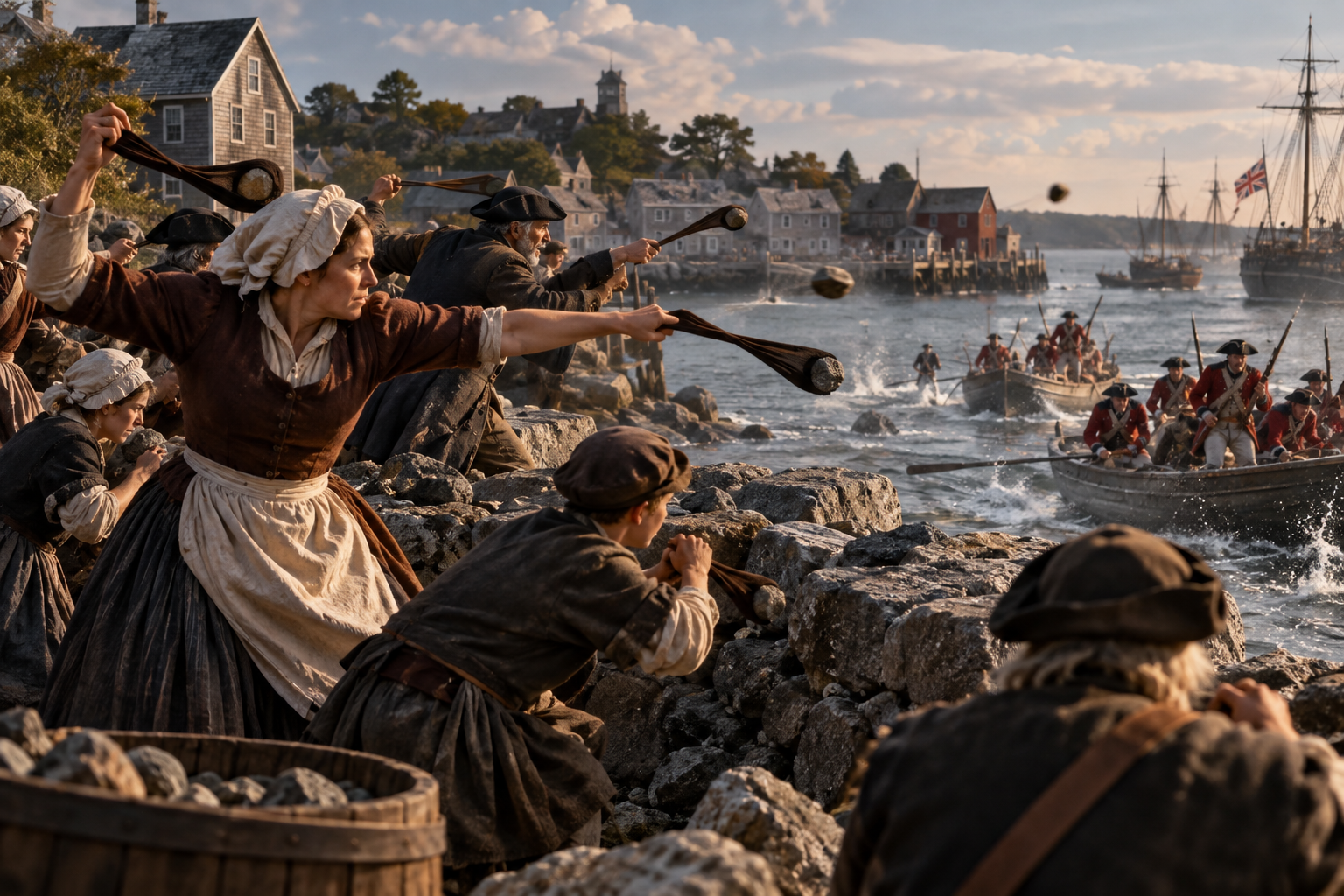
Imagine standing on Bearskin Neck in Rockport and seeing British soldiers approaching from the water. Your small coastal village is under attack: the fort that was supposed to protect you has been captured, its defenders taken prisoner, and the enemy has cannons. What do you do when you do not have enough weapons? According to one of Rockport's most remarkable historical accounts, you take off your stockings, fill them with rocks, and fight back. It sounds like something invented for a movie, but the story is recorded on a historical marker at Bearskin Neck, and it commemorates an actual British attack during the War of 1812. The most surprising part? A cannonball from that attack is still preserved in Rockport today.
Key Takeaways
On September 8, 1814, the British frigate Nymphe attacked Sandy Bay, the fishing village that later became Rockport.
The Old Stone Fort on Bearskin Neck was captured, but the meetinghouse bell kept ringing and helped rally the town.
The stocking-and-rocks story is recorded on the historical marker as local tradition, while the attack itself is documented in historical accounts.
The cannonball from the attack remains on view in Rockport today at the First Congregational Church.
On September 8, 1814, the community we know as Rockport was called Sandy Bay. It was still part of Gloucester, and it would not become its own town until 1840. Life revolved around fishing, boats, and the sea, and the War of 1812 had made that livelihood increasingly dangerous. British warships patrolled the Massachusetts coast, disrupting fishing and commerce and capturing vessels. For people whose income depended on the ocean, the threat was not something happening far away. It was right outside their harbor.
Residents organized a local defense force called the Sea Fencibles, and roughly 60 men belonged to the company. A small stone fort was established near the end of Bearskin Neck, built by public subscription with two cannons and a small garrison. It was modest by any military standard, but it represented the community's determination to protect itself.
The British frigate Nymphe appeared off Sandy Bay, and its officers wanted the town's defenses dealt with quickly. After capturing a local fishing boat, the British used its skipper to help guide two armed barges toward shore under cover of darkness and fog.
One barge landed near Long Cove and surprised the men guarding the fort. The historical marker records that all nine Sea Fencibles on duty were taken prisoner and the fort was dismantled. A second barge began moving toward the harbor, and by daybreak the village was facing a dangerous situation: British forces had taken the local defenses, and another armed party was approaching the settlement. But the British had not managed to silence the town.
As the second British barge approached, the alarm bell began ringing at the local meetinghouse, the building now known as the First Congregational Church. The ringing brought the defenders together. Members of the Sea Fencibles and local residents began firing muskets toward the barge, and the British returned fire.
Then the British tried something that would become one of Rockport's most memorable moments. They aimed a cannon at the church bell, hoping to silence the alarm. They missed the bell and struck the steeple instead. The cannonball lodged in the church structure, and the bell kept ringing.
The attempt backfired in another way too. According to historical accounts, the recoil from the British cannon damaged the barge itself, which began taking on water. Some of the sailors escaped, and others were captured as the vessel became disabled. The meetinghouse was built in 1804 and known to fishermen as the Old Sloop, because its steeple guided mariners home. On that September morning, it would not stop ringing.
This is the part of the story that makes it so unusual, and it deserves to be told carefully. The historical marker commemorating the Old Stone Fort states that residents hurled rocks using their stockings as slings. Picture the scene: a small fishing settlement facing armed British sailors, with residents improvising whatever weapons they could find.
The British attack, the capture of the fort, the church bell, the cannon fire, and the prisoners on both sides are all supported by historical accounts. The stocking-and-rocks episode is preserved in local historical tradition and on the marker, but the surviving accounts do not establish exactly how many residents took part or how important those improvised weapons were to the outcome.
That distinction makes the story more interesting, not less. The people of Sandy Bay had limited defenses and still managed to resist a Royal Navy attack. And then they did something else that was extraordinary.
After the fighting, the Americans held British prisoners while the British still held the men captured at the fort. According to historian James R. Pringle's 1892 account, Colonel James Appleton arrived with reinforcements from Gloucester and opposed an immediate prisoner exchange. But the residents of Sandy Bay wanted their neighbors back.
The historical account describes villagers disguising themselves, taking custody of the British prisoners, and arranging an exchange themselves. Think about that for a moment. They had just faced a British attack, and now they were taking matters into their own hands to bring their captured neighbors home.
The British captain subsequently agreed not to interfere with local fishing boats for the remainder of the season, and according to Pringle he honored that agreement. It was not a treaty signed by generals. It was a working arrangement between a fishing village and the captain of an enemy warship, and it held.
Here is my favorite part of this story. You can visit Rockport today and still find reminders of that extraordinary morning. At the First Congregational Church, a replica cannonball marks the place associated with the British shot, and the original cannonball is preserved inside the church. Historical accounts also identify a cannon from the British barge on the church grounds.
And on Bearskin Neck, a historical marker commemorates the Old Stone Fort and the residents who defended Sandy Bay. Most visitors come to Rockport for the harbor, the galleries, the shops, and the beautiful ocean scenery. How many of them know that this peaceful seaside destination was once attacked by the British?
If you are curious about what it is like to live here today, this answer about living in Rockport is a good place to start. The town that fought back in 1814 is the same town that fills its studios and wharves with artists every summer.
Rockport's resistance did not change the entire course of the War of 1812. But it tells us something important about the people who lived along this coastline. Their livelihood depended on the sea. British warships threatened their boats, their income, and their community. When the danger arrived, they resisted with the weapons they had, and according to local tradition, even rocks carried in stockings.
The next time you are on Bearskin Neck, look beyond the storefronts and the harbor. Imagine the church bell ringing, the British barges approaching, and the residents of Sandy Bay rushing to defend their village. More than two centuries later, the evidence of that extraordinary morning is still part of Rockport.
Ask Kathleen
Short, straight answers to the questions this story keeps raising, drawn from the historical record.
The British attack on Sandy Bay on September 8, 1814 is documented in historical accounts. The detail that residents fought back with stockings filled with rocks is recorded on the historical marker at Bearskin Neck and in local tradition, though surviving accounts do not establish exactly how many residents took part or how much those improvised weapons mattered to the outcome.
The British frigate Nymphe sent armed barges toward Sandy Bay under cover of darkness. The Old Stone Fort was captured and its defenders taken prisoner, but the meetinghouse bell kept ringing through the attack, cannon fire struck the steeple instead of the bell, and the village held British prisoners until residents arranged an exchange.
No. In 1814 the community was called Sandy Bay and was still part of Gloucester. It became the independent town of Rockport in 1840.
Yes. At the First Congregational Church in Rockport, a replica cannonball marks the spot where the British shot struck, the original cannonball is preserved inside the church, and a cannon from the British barge is on the church grounds.
Independent sites worth a look for general market and school information.

Written by
Kathleen Militello, Realtor®
The Militello Team · AI Certified Agent™ · Certified Negotiation Specialist™ · eXp Realty
Kathleen lives and works on Boston's Coastal North Shore, and Rockport and Cape Ann are at the heart of the market she serves. Whether you are buying, selling, or just curious about what life here is like, she will tell you what she really thinks: call her at (978) 500-1480 or book a conversation. No pressure, just straight talk about what makes sense for you.
Keep your reading going
This article retells the documented British attack on Sandy Bay in September 1814 as local history. The stocking-and-rocks detail is recorded on the historical marker and in local tradition; surviving accounts do not establish how many residents took part. Kathleen Militello is a Realtor® with eXp Realty, MA Salesperson License 9053343. All real estate services are offered in accordance with the Fair Housing Act and Equal Housing Opportunity.
From the page to the porch
A note can only tell you so much. Let Kathleen take you through the towns, the streets, and the options that actually fit.